To define the "distance" between words, we must first define the distance
between an ELS representing a word and a string of letters (SL) in the
text, (i.e. with d = 1)
representing the other word. Before we can do that, we must define the
distance between ELS and SL in a given array: and before we can do that,
we must define the distance between individual letters in the array.
As indicated in Section 1, we think of an array as one long line that
spirals down on a cylinder; its row length h is the number of vertical
columns. To define the distance between two letters x and x',
cut the cylinder along a vertical line between two columns. In the resulting
plane each of x and x' have two integer coordinates. and
we compute the distance between them as usual, using these coordinates.
In general, there are two possible values for this distance, depending
on the vertical line that was chosen for cutting the cylinder; if the two
values are different, we use the smaller one.
Next, we define the distance between fixed ELS e and SL e'
in a fixed cylindrical array. Set
f := the distance between consecutive letters of e,
f ' := the distance between consecutive letters of e' =
1.
l := the minimal distance between a letter of e and one
of e',
and define (e,
e') := f2 + f'2+l2+1.
We call (e, e')
the distance between the ELS e and the SL e' in the
given array; it is small if both fit into a relatively compact area.
Now there are many ways of writing Genesis as a cylindrical array, depending
on the row length h. Denote by h(e,
e') the distance (e,
e') in the array determined by h, and set h(e,
e') := 1/h(e,
e'); the larger h(e,
e') is, the more compact is the configuration consisting of e and
e' in the array with row length h. Set e = (n,
d, k) (recall that d is the skip). Of particular interest are
the row lengths h = h1, h2,....
where hi is the integer nearest to |d| /i
(1/2 is rounded up). Thus when h = h1 = |d|, then
e appears as a column of adjacent letters and when h = h2,
then e appears either as a column that skips alternate rows or as
a straight line of knight's moves. In general, the arrays in which e
appears relatively compactly are those with row length hi
with i "not too large."
The above discussion indicates that if there is an array in which the
configuration (e,e') is unusually compact, it is likely to be among
those whose row length is one of the first ten hi. (Here
and in the sequel 10 is an arbitrarily selected "moderate" number). So
setting
we conclude that (e,
e') is a reasonable measure of the maximal "compactness" of the configuration
(e, e') in any array. Equivalently, it is an inverse measure of
the minimum distance between e and e'.
Next, given a word w, we look for the most "noteworthy" occurrence
or occurrences of w as an ELS in G. For this, we chose ELS's
e = (n,d,k) with |d|
2 that spell out w for which |d| is minimal over all of G,
or at least over large portions of it. Specifically, define the domain
of minimality of e as the maximal segment Te
of G that includes e and does not include any other ELS
for w with ||< |d|.
The length of Te, relative to the whole of G,
is the "weight" we assign to e. Thus we define (e)
:= (Te)/(G),
where (Te)
is the length of Te, and (G)
is the length of G. For any two words w and w', we set
where the sum is over all ELS's e spelling out w and over
all SL's e' spelling out w'. Roughly, (w,
w') measures the maximum closeness of the more noteworthy appearances
of w as ELS's and w' as SL's in Genesis--the closer they
are, the larger is (w,
w').
When actually computing (w,
w'), the size of the list of ELS's for w may be impractically
large (especially for short words). It is clear from the definition of
the domain of minimality that ELS's for w with relatively large
skips will contribute very little to the value of (w,w')
due to their small weight. Hence, in order to cut the amount of computation
we restrict beforehand the range of the skip |d|D(w)
for w so that the expected number of ELS's for w will be
10. This expected number equals the product of the relative frequencies
(within Genesis) of the letters constituting w multiplied by the
total number of all equidistant letter sequences with 2 |d|D. (The latter is given by the formula (D - 1)(2L
- (k - 1)(D + 2)), where L is the length of the text
and k is the number of letters in w). Abusing our notation
somewhat, we continue to denote this modified function by (w,w').
A.2 The Corrected Distance.
In the previous section we defined a measure (w,
w') of proximity between two words w and w' -- an inverse
measure of the distance between them. We are, however, interested less
in the absolute distance between two words, than in whether this distance
is larger or smaller than "expected". In this section, we define a "relative
distance" c(w, w'), which is small when w is "unusually
close" to w', and is 1, or almost 1, when w is "unusually
far" from w'.
The idea is to use perturbations of the arithmetic progressions that
define the notion of an ELS. Specifically, start by fixing a triple (x,y,z)
of integers in the range {-r,...,0,...,r}; there are (2r
+ 1)3 such triples. In Witztum et al. (1994) and
also here we put r = 2. which gives us 125 triples. Next, rather
than looking for ordinary ELS's (n,d,k), look for "(x,y,z)-perturbed
ELS's" (n,d,k)(x,y,z) obtained by taking the positions
n, n + d,...,n + (k - 4)d, n + (k - 3)d
+ x, n + (k - 2)d + x + y, n + (k - 1)d + x
+ y + z,
instead of the positions n, n + d, n +2d,...,n +(k - 1)d.
Note that in a word of length k, k-2 intervals could be perturbed.
However, we preferred to perturb only the 3 last ones, for technical programming
reasons.
The distance between the (x,y,z)-peturbed ELS (n, d,
k)(x,y,z) and the SL (n', 1,k')
is defined by the same formulae as in the non-perturbed case, where f
is taken to be the distance between the first two letters of (x,y,z)-perturbed
e.
We may now calculate the "(x,y,z)-proximity" of two words w
and w' in a manner exactly analogous to that used for calculating
the "ordinary" proximity (w,
w'). This yields 125 numbers (x,y,z)(w,
w'), of which (w,w')=(0,0,0)(w,w')
is one. We are interested in only some of these 125 numbers; namely, those
corresponding to triples (x,y,z) for which there actually exist
some (x,y,z)-perturbed ELS's in Genesis for w (the other (x,y,z)(w,w')
vanish). Denote by M(w, w') the set of all such triples,
and by m(w, w') the number of its elements.
Suppose (0,0,0) is in M(w, w'), i.e., w actually
appears as ordinary ELS (i.e., with x = y = z = 0) in the text.
Denote by v(w,w') the number of triples (x,y,z) in
M(w,w') for which (x,y,z)(w,w')(w,w').
If m(w,w') 10
(again, 10 is an arbitrarily selected "moderate" number),
c(w,w') :=v(w,w')/m(w,w').
If (0, 0,0) is not in M(w, w'), or if m(w, w')
< 10 (in which case we consider the accuracy of the method as insufficient),
we do not define c(w,w').
In words, the corrected distance c(w,w') is simply the
rank order of the proximity (w,w')
among all the "perturbed proximities" (x,y,z)(w,w');
if (w,w')
is tied with other (x,y,z)(w,w'),
half of these others are considered to "exceed" (w,w').
We normalize it so that the maximum distance is 1. A large corrected distance
means that ELS's representing w are far away from the SL's representing
w', on a scale determined by how far the perturbed ELS's
for w are from the SL's for w'.
 1)
representing the other word. Before we can do that, we must define the
distance between ELS and SL in a given array: and before we can do that,
we must define the distance between individual letters in the array.
1)
representing the other word. Before we can do that, we must define the
distance between ELS and SL in a given array: and before we can do that,
we must define the distance between individual letters in the array.
 h(e,
e') the distance
h(e,
e') the distance  h(e,
e') := 1/
h(e,
e') := 1/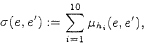
 (e,
e') is a reasonable measure of the maximal "compactness" of the configuration
(e, e') in any array. Equivalently, it is an inverse measure of
the minimum distance between e and e'.
(e,
e') is a reasonable measure of the maximal "compactness" of the configuration
(e, e') in any array. Equivalently, it is an inverse measure of
the minimum distance between e and e'.
 2 that spell out w for which |d| is minimal over all of G,
or at least over large portions of it. Specifically, define the domain
of minimality of e as the maximal segment Te
of G that includes e and does not include any other ELS
2 that spell out w for which |d| is minimal over all of G,
or at least over large portions of it. Specifically, define the domain
of minimality of e as the maximal segment Te
of G that includes e and does not include any other ELS  for w with |
 |< |d|.
The length of Te, relative to the whole of G,
is the "weight" we assign to e. Thus we define
|< |d|.
The length of Te, relative to the whole of G,
is the "weight" we assign to e. Thus we define  (e)
:=
(e)
:=  (Te)/
(Te)/
 (w,
w') measures the maximum closeness of the more noteworthy appearances
of w as ELS's and w' as SL's in Genesis--the closer they
are, the larger is
(w,
w') measures the maximum closeness of the more noteworthy appearances
of w as ELS's and w' as SL's in Genesis--the closer they
are, the larger is  D(w)
for w so that the expected number of ELS's for w will be
10. This expected number equals the product of the relative frequencies
(within Genesis) of the letters constituting w multiplied by the
total number of all equidistant letter sequences with 2
D(w)
for w so that the expected number of ELS's for w will be
10. This expected number equals the product of the relative frequencies
(within Genesis) of the letters constituting w multiplied by the
total number of all equidistant letter sequences with 2